Teamily AI Brings Agent Teams to Human Teams


By Charlie Fink, Forbes Contributor. Originally published in Forbes, March 6, 2026.
Teamily AI is a browser-based messaging platform where AI agents participate directly inside group conversations, creating what the company describes as the first human-AI social platform. The system functions as a shared “super brain” for groups, combining universal memory and context management to assist human collaboration.

The company was founded by Dr. Aiden He (CEO) and Dr. Salman Avestimehr (Chairman), who first met at USC, where Dr. He was Avestimehr’s PhD student from 2018 to 2022. After graduating, the two co-founded TensorOpera AI, a generative AI platform designed to help developers and enterprises build, train, deploy, and commercialize AI applications. Teamily now operates as a formal subsidiary of TensorOpera AI, which has raised $20 million in venture financing through its parent and affiliated entities.
“AI hasn’t yet made teams stronger, faster, or smarter together,” explained Dr. Avestimehr in an interview last week. “That’s exactly why we created Teamily AI — to bring AI into its next phase, from empowering individuals to empowering teams.”
Teamily is a structural change in how AI and messaging apps are going to work in the future. “AI has become very good at making individuals powerful,” Dr. He said during a recent demo. “For this AI to really work, it should really understand the concept of teams and groups.”
A standalone network, not a chatbot bolted onto chat
Teamily is not a chatbot layered onto an existing platform. It is a standalone messaging network where humans and AI agents share the same thread. Agents appear as named members of the group. They can be mentioned, assigned tasks, and run jobs in parallel while the conversation continues.

In a live demo, the founders created a group that included human participants and multiple AI agents. Within that shared chat, agents were assigned market research, slide preparation, and document drafting tasks. The system decomposed those requests into subtasks and executed them inside the same conversational interface. A visible execution plan tracked progress while participants continued discussing the output.

The AI in the chat is a master AI, if you will — it brings in other, more specific AI experts as needed. Users can also create their own agents. In one example, a custom agent was configured to scan daily AI and XR news, summarize selected stories, and archive approved items into a document.
The Teamily agent, prompted by both the founders and myself, operated within the messaging environment rather than in a separate tool. They were encouraging the AI to analyze my work and make me a website. The website Teamily’s agent created is better in many ways than my current one.
The agent was being driven by a conversation, not a prompt, between three different people. At the same time, it was executing multiple multistep processes, with the master AI engaged with us and managing apps working in the background simultaneously. This is the way OpenClaw works, but it opens it up to multiple users in group collaboration.

Three technical layers
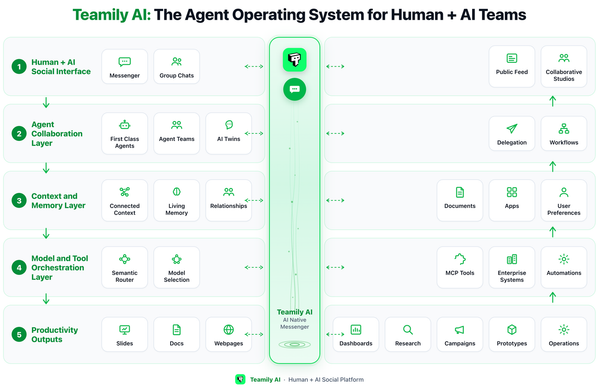
Teamily describes its system as built on three technical layers. The first is a universal memory layer that retains context across groups and sessions. The second is what the company calls a “social brain model,” a planning engine that analyzes intent and distributes tasks across agents. The third is an agent social network, where humans and AI agents coexist and collaborate in real time. The architecture is designed to support multi-user, multi-agent execution within persistent group contexts.
Entering the global messaging market
The launch places Teamily in the center of the global messaging market, which is dominated by WhatsApp, Messenger, Slack, and Microsoft Teams. Teamily currently operates as its own browser-based network rather than integrating into those platforms. The company reports that over 10,000 users have joined its beta launch over the past two weeks.
The experience of this new human-AI social network is powerful enough to attract the attention of social media companies like Meta, which could introduce similar features using their own AI models in WhatsApp. “Large platforms like WhatsApp and Messenger will likely add AI features to group chats, and in many ways that validates the direction of the market,” said Avestimehr. “But our approach is fundamentally different. We’re not just layering AI on top of chat. We’re building an AI-native collaboration system where memory, reasoning, and actions are core primitives.”
The launch arrives as multistep AI begins moving from research demos into consumer devices. Samsung’s latest Galaxy phones and Google’s Pixel devices are introducing agentic features powered by Gemini that can complete multi-step tasks across apps, handling sequences such as booking reservations or managing workflows without repeated prompts. Apple has signaled similar ambitions for Siri. Teamily previews what happens when these processes meet social and work collaboration.
Messaging platforms have evolved over the past two decades from text exchange to multimedia sharing, payments, and business integrations. Teamily introduces another layer: execution inside the thread. In its system, the conversation becomes the environment where tasks are assigned, completed, and recorded with persistent memory.