Teamily AI Envisions an Open, Social, and Appless Agentic Internet Powered by Human-Agent Teams

Rather than replacing human workers, Teamily AI is building a platform where employees, customers and AI agents collaborate, share knowledge, and work to get more done.
Many AI companies are racing to build the perfect personal assistant. Teamily AI thinks they're solving the wrong problem.
Today’s AI agents can write reports, analyze data, and develop software, but AI has a teamwork problem. Most AI tools operate independently, responding to individual requests without retaining the context of an ongoing project or maintaining the information needed to contribute to a larger team effort.
Teamily AI takes a different approach. The company developed a platform where people and AI agents build together, work as one team, connect to the tools and channels where work already happens, and grow smarter with every project. The platform is designed for many people working with many agents at once, not a single user talking to a single AI.
It's a departure from the familiar conversation about whether AI will eventually replace human workers, and from the personal AI agents now going viral. Teamily's premise, and its founders’ vision, is that the future of work is a collaborative one.
Multi-user Multi-agent Collaborative AI Platform
Using an AI platform can be an exercise in repetition: explaining the same project, uploading the same documents, or correcting information an application should have maintained. Every new chat means starting over.
Teamily aims to eliminate that repetition through its “living memory,” where persistent, shared context can allow AI agents to retain relevant information and build on previous interactions.
Combining this approach with integrated productivity tools could allow human and AI team members to collaborate on projects without constantly starting over.
In one reported demonstration, Teamily revealed how a group of specialized AI agents could tackle five different assignments simultaneously. Working within a shared conversation, the agents in this internal study produced market research, financial analysis, an interactive website, an executive briefing, and a presentation. Human participants could follow the progress and review the finished materials without switching between applications.
The demonstration illustrated one of Teamily's central ideas: AI can do more than complete isolated tasks. When agents share information and coordinate work, they can contribute to the larger project while keeping people involved.
The company’s goal isn’t just faster work. It’s a collaborative result with less time spent managing technology.
Built on Years of AI Research
Teamily's ambitions reflect the backgrounds of its co-founders, Dr. Aiden Chaoyang He and Professor Salman Avestimehr.
He, Teamily's co-founder and CEO, is an AI entrepreneur and technologist with deep expertise in large-scale AI infrastructure, distributed machine learning, and foundation models, having previously worked on advanced AI systems at Meta and AWS AI. Avestimehr, Teamily's co-founder and president, is a USC Dean's Professor, IEEE Fellow, and director of the USC–Amazon Center on Trustworthy AI, recognized for his pioneering research in distributed and collaborative AI.
Their earlier ventures, FedML and TensorOpera AI, focused on the infrastructure needed to train, deploy, and operate sophisticated AI models on distributed data.
That experience shaped a layered view of collaborative AI. It began at the model and infrastructure layer, where systems learn across distributed data and machines, and has now moved up to the application layer, where people and AI agents collaborate as teammates. That philosophy now drives Teamily, connecting years of foundational research with an application designed for everyday business.
Making A Truly Open, Social, and Appless Agentic Internet
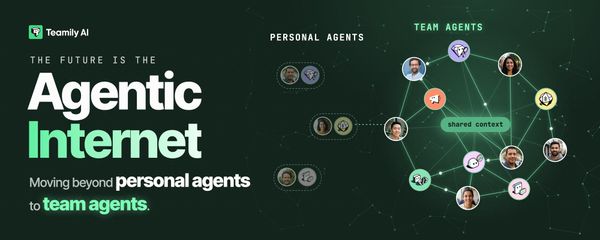
“Teamily AI's long-term vision is to build the central platform of the next-generation Agentic Internet, where services and work are delivered by AI agents, no longer wrapped inside traditional web, desktop, or mobile apps distributed through app stores or search engines. AI agents will be as accessible as friends on a social network. Every user intent will be enriched with complete context and the right intelligence, then intelligently routed to the right people, agents, and services,” said Dr. Aiden He, co-founder and CEO of Teamily AI. “Just as Google democratized access to information and services in the web era, Teamily AI aims to democratize access to intelligence and services in the Agentic Internet era, making the right intelligence, people, and services equally accessible to everyone.”
Teamily AI starts with an AI-native messenger that enables humans and agents to create, collaborate, and grow together. Human-AI collaboration extends beyond automating routine tasks. Teamily's platform is organized around what a team of people and agents does together: build, collaborate, communicate, connect, and grow.
Build and manage. Teams can create custom agents and assemble them into agent teams, then put those teams to work producing websites, email, slides, documentation in Docs, PDF, and Excel, video, and images.
Collaborate. People and agents work in human-agent group chats or one-on-one, inside a real-time, multi-user studio for creating almost anything. Automations and the Agent Loop turn recurring human-agent workflows into repeatable processes; agents can join human meetings, and a Discover community lets people share, get inspired by, and remix agent deliverables.
Communicate. Prompts can be multimodal and come from several users at once; every agent has its own email, and people can reach an agent by voice or video call.
Connect. Agents plug into channels and agentic APIs, draw on a skill library, and use app connectors to reach the systems a team already relies on.
Grow. A self-evolving memory helps make agents smarter over time; artifacts keep chat, meetings, deliverables, systems, and applications in one shared context; and an agent workspace manages agent messages and email and hosts agentic websites with traffic analytics.
Shared knowledge like this can help employees coordinate projects, reduce duplicated work, and maintain continuity as responsibilities and personnel change. Teamily publicly launched in July 2026 and says it has since grown from 10,000 to 320,000 sign-ups in a single quarter, a 32× increase, with 20,000 daily active users and several thousand paying customers. The company also says 10,000 company teams have already brought their coworkers onto the platform, each running an average of 6 agent tasks per day.
Teamily’s underlying idea is straightforward: taking people out of the team doesn’t make work better. Bringing humans and AI together, however, could create opportunities to build a future neither could achieve alone. The company says the platform already delivers business value through an AI workforce, team-owned intelligence, and human-agent collaboration. Looking ahead, Teamily team says it plans to announce a major milestone in Q4 2026, expanding into agentic commerce, agentic mini apps, and open model infrastructure—bringing people closer to a truly open, social, and appless Agentic Internet.