The Future Is the Agentic Internet: Moving Beyond Personal Agents to Team Agents

Dear Teamily AI Customers, Ecosystem Partners, and Investors,
Over the past few months, Teamily AI has grown rapidly, and we're grateful to everyone who has joined us on this journey.
In this letter, we'd like to share our growth, reflect on our early foresight, what we've built, how we see the evolving AI agent landscape, and where we're heading next.
Our ambition goes beyond building another AI agent product. We're building a future where people and AI agents work, learn, and grow together, and where Agent-as-a-Service (AaaS) becomes accessible to everyone, as easily as adding a friend on a social network.
Thank you for being part of this journey.
Growth
1. Explosive User Growth — 32× in One Quarter
Teamily AI grew from 10K to 320K sign-ups in just one quarter, achieving 32× user growth and a 217.5% compound monthly growth rate (MoM).
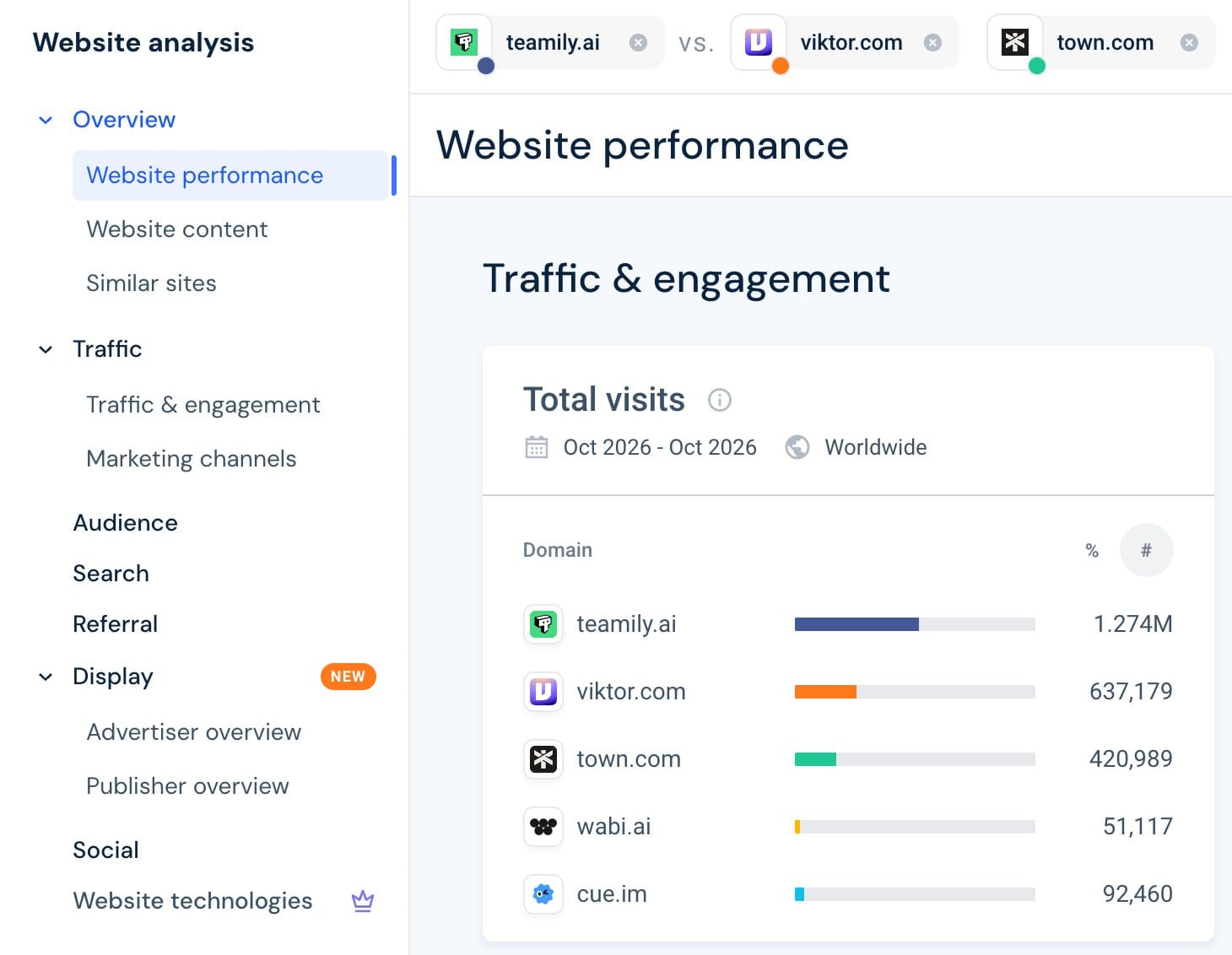
According to publicly available SimilarWeb traffic data, Teamily AI has already surpassed agent products such as Town.com, Viktor.com, wabi.ai, and cue.im, companies that have reportedly raised 100M–400M at billion-dollar valuations. This highlights Teamily's strong competitive momentum and growth potential.
2. High-Quality Users — Strong Monetization and Team Adoption
Beyond rapid user acquisition, Teamily demonstrates strong user quality and early monetization. Several thousand customers have subscribed to paid plans. Its freemium and advertising-based business model is further supported by 20K daily active users (at least running one prompt for agentic task), generating additional revenue streams.
More importantly, 10K company teams have connected coworkers on Teamily, demonstrating organic team adoption and validating the differentiated value of its multi-user, human–agent collaboration platform. This team-based network effect creates a foundation for stronger engagement, retention, and expansion.
In response to growing inbound interest from enterprises, Teamily offers enterprise services that enable fine-grained access control for AI agents, private knowledge base management, and private model training and serving behind enterprise firewalls.
We're also seeing promising use cases for hybrid agent workflows, where local agents process sensitive data securely on-premises, while cloud-based agents leverage larger, frontier AI models for advanced analytics and content creation.
3. Technical Moat — Proprietary AI Infrastructure and Scalable Unit Economics
Teamily's rapid growth is creating a compounding technical and data advantage. The platform has processed over 100 million messages, about 35% generated by AI agents, producing valuable interaction data that continuously improves model training, inference efficiency, and cost optimization.
Unlike competitors that rely primarily on third-party model APIs, Teamily develops and trains its own LLMs and self-hosted inference infrastructure. Using insights and monitoring from real traffic, its optimized model-serving system has achieved 30% higher throughput than publicly reported vLLM/SGLang benchmarks while maintaining positive gross margins per paying user.
Cost efficiency is fundamental to sustainable growth. As Elon Musk highlighted (https://x.com/elonmusk/status/2116992258520064397), operating AI agents like Grok Bots comes with significant costs. Through continuous optimization, we've brought our operating costs below our pricing, ensuring a healthy, scalable business model while building a strong technical and economic moat.
Together, proprietary models, high-performance inference, and growing human–agent interaction data create a self-reinforcing technical and economic moat: more users generate more data, better models improve product quality, and lower inference costs enable profitable scaling.
Ahead of the Curve: Pioneering Multi-Agent Collaboration Before Grok Bots and OpenAI Dots
In February 2026, more than half a year before personal and team AI agents became mainstream, we publicly introduced Teamily around a simple idea: humans and multiple AI agents working together as one team, sharing a unified context and building memory that compounds over time. Here's how our co-founders introduced this vision back then:
Introducing Teamily AI: the world's first human + AI social network, built for better connection and collaboration.
— Teamily AI (@Teamily_AI) February 12, 2026
This is the first time our founders @AidenChaoyangHe and @avestime speaking on camera in this way — because they genuinely wanted to share Teamily AI with you… pic.twitter.com/K5B2bfOMd3
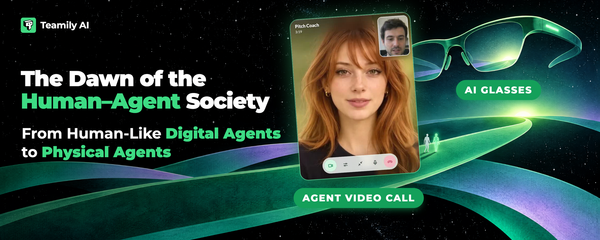
Vision: Moving Beyond Personal Agents to Team Agents, Towards the Agentic Internet
Teamily AI's long-term vision is to build the central platform of the next-generation Agentic Internet, where services and work are delivered by AI agents, no longer wrapped inside traditional web, desktop, or mobile apps distributed through app stores or search engines. The recent growth has further strengthened my confidence in pursuing this vision.
Agent-as-a-service (AaaS) will be as accessible as adding friends on a social network. Just as Google democratized access to information and services in the web era, Teamily AI aims to democratize access to intelligence and services in the Agentic Internet era, making the right intelligence, people, and services equally accessible to everyone.
Starting with an AI-Native Messenger. Rather than attempting to build the entire Agentic Internet at once, Teamily AI is starting with something people already understand: messaging.
Our reinvented AI-native messenger brings humans and AI agents into a shared environment where they can communicate, create, collaborate, and continuously build intelligence together.
Unlike single-user personal agents, Teamily AI enables multi-user, multi-agent teamwork. Built on an AI-native messenger, Teamily connects people, agents, docs, meetings, calls, workflows, and business systems to automate office work and customer service. Agents become real teammates with persistent memory, proactive intelligence, and continuous self-improvement.
We believe this social-native architecture is a critical foundation for the Agentic Internet. Just as social networks connect people, Teamily aims to connect people, agents, and services into a continuously expanding network of collaborative intelligence.
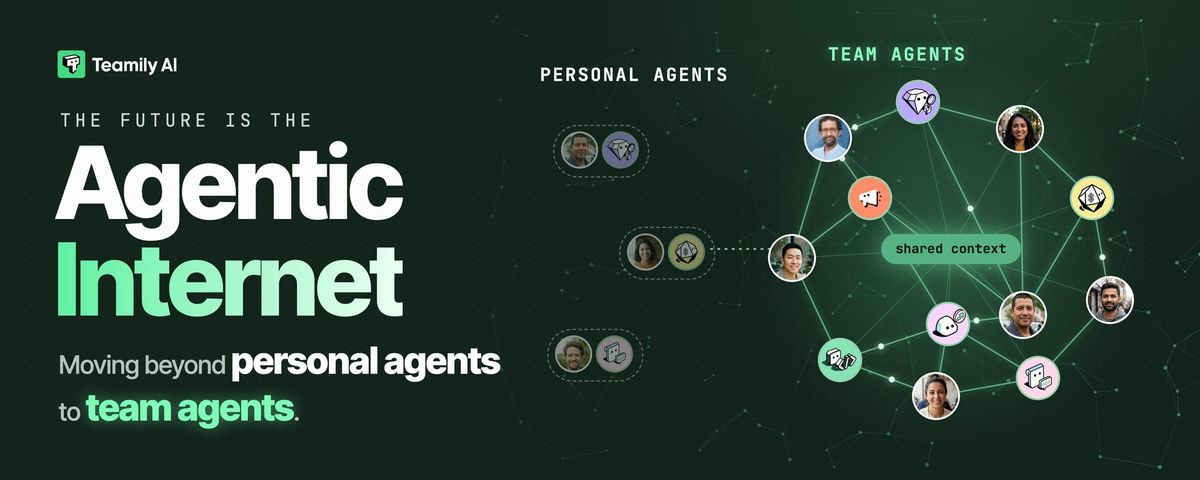
Personal agents are an important step, but they are not the final destination. The future is not billions of isolated personal assistants. It is billions of people and agents connected through a shared network of intelligence, where every individual and every business can access the capabilities they need.
Multi-user Multi-agent Collaborative AI Platform
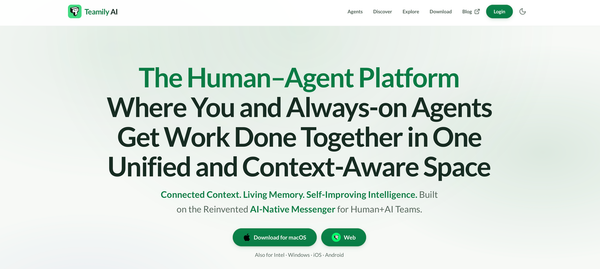
Just last month, we launched Teamily AI 2.0, the human–agent platform where you and always-on AI agents get work done together in one unified, context-aware space.
We've taken four major capabilities to the next level to help businesses build and grow faster:
- Real-Time Human–Agent Collaboration. Humans and AI agents work together across chats, meetings, studios, and communities to research, analyze, and create websites, dashboards, videos, slides, documents, and more.
- Unified Context & Living Memory. One connected context across conversations, meetings, channels, and workspaces. Your AI agents remember, learn, and understand you over time—delivering smarter, more personalized results.
- Custom Agents & Agent Teams. Create and orchestrate AI agent teams in one click. Manage agents through Agent Workspace, connect them to Telegram, WhatsApp, iMessage, and Slack, or integrate them into your products via Agent API.
- Intelligent Multi-Model Routing. Our proprietary models work alongside leading models from OpenAI, Anthropic, Gemini, DeepSeek, Qwen, Kimi, MiniMax, and more—automatically routing each task to the best model across text, image, video, and voice.
Teamily AI 2.0 is built for every business owner, every employee, and every customer. Watch the short video below to see Teamily AI 2.0 in action.
150,000 small business owners and employees are already using Teamily AI. Today, we're opening it to everyone: your personal AI agent and an entire team of AI agents, ready to work for you and your business.
— Teamily AI (@Teamily_AI) October 8, 2026
Meet Teamily AI 2.0 — the human–agent platform where you and always-on… pic.twitter.com/Ank8fievnQ
The video provides an overview of all the key features. Here, we'd like to highlight one in particular: Living Memory.
Using AI platforms often involves frustrating repetition, explaining the same project, uploading the same documents, or correcting information the system should already remember.
Teamily aims to eliminate this repetition through Living Memory, a persistent, shared context that enables AI agents to remember relevant information, learn from previous interactions, and continuously build on accumulated knowledge over time.
Combining this approach with integrated productivity tools could allow human and AI team members to collaborate on projects without constantly starting over.
In one of our customer use cases, Teamily revealed how a group of specialized AI agents could tackle five different assignments simultaneously. Working within a shared conversation, the agents in this internal study produced market research, financial analysis, an interactive website, an executive briefing, and a presentation. Human participants could follow the progress and review the finished materials without switching between applications.
This illustrates one of Teamily's core beliefs: shared context is the foundation of collaborative intelligence and the Agentic Internet. With unified context and living memory, AI agents can move beyond isolated tasks to understand user intent, coordinate with other agents and people, and continuously build on previous work. This lays the foundation for an Agentic Internet where the right intelligence, agents, people, and services are seamlessly connected to get work done together.
Business Values
We've also outlined many of Teamily's core values and how they address real-world user needs in our previous article, What Problems We Learn from Users and How We Solve Them.
Our recent growth and user feedback have further reinforced our confidence in Teamily's core value proposition.
1. AI Workforce — Expand What Every Team Can Accomplish
Teamily enables small businesses to build and deploy their own AI workforce, including Marketing Agents, Sales Agents, Research Agents, and Operations Agents.
Instead of hiring separately for every specialized function, businesses can extend their existing teams with always-on AI capabilities that help them research markets, acquire customers, create content, manage operations, and execute recurring tasks.
The goal is not simply to automate existing work, but to enable smaller teams to pursue opportunities and deliver services that previously required much larger organizations.
2. Team-Owned Intelligence — Turn Business Knowledge into a Compounding Asset
Teamily helps organizations transform conversations, customer projects, documents, workflows, and institutional knowledge into reusable, permission-controlled context and specialized agent capabilities.
Rather than allowing business intelligence to remain fragmented across individual employees, disconnected applications, and isolated AI conversations, teams can build and own their own intelligence assets.
Over time, these assets can become increasingly valuable as agents accumulate relevant context, adapt to business workflows, and improve through ongoing human–agent collaboration.
3. Human–Agent Collaboration — Work Together, Not in Separate Tools
Teamily connects humans, AI agents, and external business systems through group chats, meetings, collaborative workspaces, and Loop automation.
People and agents can jointly research, plan, create, review, and execute work within the same environment. From producing websites, presentations, videos, and business reports to orchestrating recurring operational workflows, Teamily aims to turn everyday conversations into coordinated action.
Our real-time user behavior analytics show that each human-agent group runs an average of 6 agent tasks per day, and our customers create more than 300 group-level agentic automation loops every day. Based on our user data, we've identified the most frequently performed agentic tasks, ranked by usage frequency as follows:
These insights help us better prioritize our investments and allocate resources to meet our users' evolving needs.
Built on Years of AI Research
The Agentic Internet is an ambitious vision. Beyond our rapid user growth, another major source of conviction comes from years of foundational AI research.
From data and models to AI agents, we've continuously advanced collaborative AI through research in algorithms, system design, security, and privacy. This deep technical foundation gives us confidence that the Agentic Internet is not only technologically achievable, but can also become a commercially viable reality.
Dr. Aiden Chaoyang He, Teamily's co-founder and CEO, is an AI entrepreneur and technologist with deep expertise in large-scale AI infrastructure, distributed machine learning, and foundation models, having previously worked on advanced AI systems at Meta, AWS AI, and Tencent.
Professor Salman Avestimehr, Teamily's co-founder and president, is a USC Dean's Professor, IEEE Fellow, and Director of the USC–Amazon Center on Trustworthy AI, recognized for his pioneering research in distributed and collaborative AI.
Each has got more than 20,000 research citations in fields related to collaborative AI. Our earlier ventures, FedML and TensorOpera AI, focused on building the infrastructure needed to train, deploy, and operate sophisticated AI models across distributed data and computing environments.
That experience shaped our layered approach to collaborative AI. It began at the model and infrastructure layers, where systems learn across distributed data and machines, and has now expanded to the application layer, where people and AI agents collaborate as teammates.
This philosophy now drives Teamily, connecting years of foundational research with practical applications designed for everyday business needs.
The Next Step: Teamily AI Ecosystem
To accelerate its evolution from an AI-native collaboration platform into an open Agentic Internet, Teamily AI is preparing Teamily 3.0, centered on a major ecosystem expansion initiative.
This initiative will expand the platform across seven interconnected areas:
- Agentic Commerce and Wallets: Integrating digital wallets and merchant systems to enable AI agents to participate in commerce, payments, and service transactions across a broader business ecosystem.
- Creative Studio and Plugins: Enhancing existing high-value creative capabilities through more user-friendly plugins for videos, images, presentations, spreadsheets, websites, and other professional deliverables.
- AI-Native Data Hub: Unifying fragmented data across cloud storage, documents, and business systems, enabling agents to organize, analyze, and act on distributed data with appropriate access controls.
- Agentic Mini Apps and Agent Network: Enabling developers to bring agentic applications into Teamily as independently accessible agents, discoverable and connectable as easily as adding friends on a social network. The initial phase will prioritize integrations with trending personal agents such as Muse, Grok Bots, Open AI Dots, and Claude Duet.
- Deep Business App Connectors: Building deeper integrations with essential enterprise and business applications to enable reliable, end-to-end agentic workflows.
- Appless Distribution: Extending Teamily's existing Channels capabilities beyond messaging platforms, enabling agents to operate directly within third-party products and services without requiring users to open a dedicated app.
- Open Model and Infrastructure Ecosystem: Partnering with AI model developers, data providers, and infrastructure companies from day zero, helping emerging technologies reach users through coordinated integrations, launches, and distribution. In particular, we look forward to partnering with AI model developers whose technologies enable deeper human–agent collaboration and unlock powerful network effects in the agentic era.
Together, these initiatives will lay the foundation for an open Agentic Internet where developers can distribute intelligent services, businesses can build and own specialized intelligence, and users can discover and access AI agents as naturally as connecting with friends on a social network, moving beyond the boundaries of traditional apps.
Looking Ahead: Building the Agentic Internet Together
From rapid user growth and real-world adoption to years of foundational AI research, our journey has strengthened our conviction in the future of the Agentic Internet.
We believe Teamily is building an increasingly defensible platform, with long-term competitive moats rooted in proprietary collaborative data, a multi-model agent harness architecture, private model training and deployment, and commercialization-driven network effects. As more people, agents, developers, and businesses join the platform, these advantages can reinforce one another, creating compounding intelligence and value across the ecosystem.
We firmly believe that human–agent collaboration will become a fundamental product paradigm across industries, transforming how people work, businesses operate, and intelligent services are delivered.
Ultimately, our ambition is not just to build a successful AI product, but to grow alongside our ecosystem partners and build a healthy, sustainable Agentic Internet economy—where users, developers, businesses, and AI innovators can all create, share, and capture value.
We're still at the beginning of this journey, and we look forward to building this future together.
Cheers,
The Teamily AI Team